

Local vs. Overseas Promotional Product Suppliers: Which Makes More Sense?
Posted in :
Choosing between local vs overseas promotional product suppliers isn’t always a simple question of price.
A local supplier may offer faster delivery, easier communication and fewer shipping arrangements to manage. An overseas supplier may provide more flexibility with product specifications, customization and larger quantities.
The better choice depends on what you’re ordering, how much you need, when you need it and how much of the sourcing process you’re comfortable managing.
Local vs. Overseas Promotional Product Suppliers: The Main Differences
Imagine you’re organizing an event and need 200 branded notebooks by next Friday.
You probably don’t want to spend the next few days comparing overseas freight options or checking customs requirements. A local promotional product distributor with available stock may be the most practical choice.
Now imagine you’re planning a company-wide campaign involving 3,000 customized welcome kits. You have several months to prepare, and you want the bags, bottles and stationery to follow a consistent design.
In that situation, overseas sourcing may be worth exploring.
Neither approach is automatically better. They solve different purchasing problems.
| Factor | Local Supplier | Overseas Supplier |
|---|---|---|
| Small, urgent orders | Often more convenient | May be less practical |
| Larger custom orders | Convenient, but options vary | Often worth comparing |
| Product selection | Depends on local stock and sourcing network | May offer more manufacturing options |
| Communication | Same or similar time zone | Requires coordination across time zones |
| Shipping and customs | Often handled before delivery to the buyer | Depends on the agreed shipping terms |
| Quality control | Local samples or inspection may be easier | Requires clear approvals and pre-shipment checks |
Keep in mind that many local promotional product companies also source their merchandise internationally. The real difference is often who manages the sourcing, customization, shipping and delivery process.
When a Local Supplier Makes More Sense
There are good reasons why businesses continue working with promotional product distributors in their own country.
You need the products quickly.
If an event is only a week or two away, products already available in a local warehouse can be a major advantage.
You’re ordering a relatively small quantity.
For 50 or 100 standard items, international freight and customization setup costs may outweigh any difference in unit price.
You want a straightforward purchasing process.
A local distributor may be able to provide a quote in your currency, arrange domestic delivery and handle the import process without involving your purchasing team.
Your organization has specific procurement requirements.
Some companies, schools and public institutions have approved supplier lists or purchasing policies that make local buying easier.
For these projects, convenience and predictability can matter more than finding the lowest factory price.
When Overseas Sourcing Is Worth Considering
Overseas suppliers become more interesting when the order involves larger quantities, detailed customization or products that aren’t readily available from local stock.
For example, suppose you need 2,000 cotton tote bags for a promotional campaign.
You want a particular fabric weight, a custom bag size, longer handles and a specific print position.
A local distributor may be able to arrange all of this. But if the order is being manufactured overseas anyway, working with an overseas sourcing partner may give you more direct involvement in material selection, sampling and production details.
The same applies to promotional products such as custom drinkware, embroidered caps, lanyards, packaging and coordinated merchandise sets.
However, overseas sourcing isn’t automatically cheaper or better. The result depends on the product, order quantity, supplier capability and shipping arrangements.
It’s worth comparing the full quotation rather than assuming that one purchasing route will always win.
If you’re considering sourcing directly from China for the first time, our first-time guide to buying promotional products from China explains what to check before placing an order, from product specifications and artwork approval to shipping arrangements.
Compare the Total Cost, Not Just the Unit Price
This is where purchasing decisions can become misleading.
Suppose you’re comparing quotations for 1,000 branded bottles.
A local supplier quotes $5,200 for the complete order, including domestic delivery.
An overseas supplier quotes $3,800, but you still need to confirm what that amount includes.
At first glance, the overseas offer looks significantly cheaper.
But what happens if international freight, import charges, artwork setup and local delivery haven’t been included?
The difference could become much smaller.
These figures are hypothetical and are used only to illustrate how quotations can differ.
Before comparing local vs overseas promotional product suppliers, ask for a clear breakdown of:
- Product cost and customization
- Artwork or printing setup fees
- Sample charges, if applicable
- International freight
- Customs duties and import taxes, where applicable
- Final delivery to your address
- Any additional handling or documentation charges
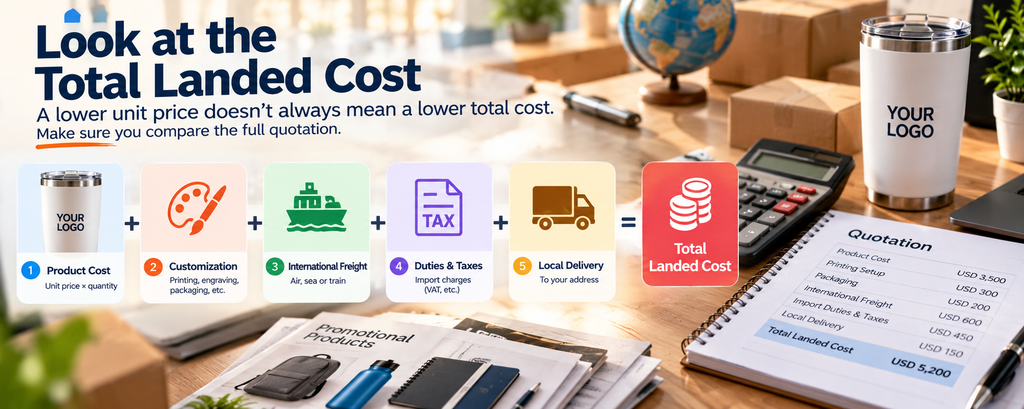
If VAT or another import tax is recoverable by your business, consider that separately when calculating the actual cost.
The most useful comparison is between quotations that cover the same product specifications and delivery responsibilities.
A cheaper unit price doesn’t necessarily mean a cheaper completed order.
Lead Times, Customs and Delivery Responsibilities
Delivery time is another area where local and overseas purchasing can differ.
A local supplier may be able to dispatch standard products quickly if they are already in stock.
For custom-made products, however, production may still take several weeks, regardless of whether you place the order through a local distributor or an overseas supplier.
When sourcing internationally, allow time for artwork approval, sampling if needed, production, shipping and customs clearance.
Also ask what the shipping quotation actually covers.
For example, under DAP and DDP arrangements, responsibilities for import clearance and duties are different.
The International Chamber of Commerce provides a guide to DAP and DDP Incoterms® that explains how these arrangements work.
Don’t assume that a quotation described as door-to-door automatically includes import duties or taxes.
And if you have an important event deadline, tell the supplier when the products must arrive at your warehouse or venue—not just the event date.
You may need extra time for unpacking, distribution or preparing giveaway bags.
Quality Checks and Customization
One advantage of working locally is that inspecting samples or discussing problems may feel easier.
But product quality isn’t determined by the supplier’s country alone.
Whether you’re buying locally or overseas, the important question is how the supplier confirms the agreed specifications before production.
Take a custom cotton bag as an example.
Two quotations may look similar, but one could refer to 140gsm fabric with a basic print, while another includes 220gsm cotton, a gusset and reinforced handles.
If those details aren’t confirmed, you’re not comparing the same product.
Before approving a custom order, check:
- Material, dimensions and construction
- Logo placement, size and colors
- Printing or embroidery method
- Packaging requirements
- Approved artwork or physical samples
- Pre-shipment inspection arrangements
For straightforward products, a digital artwork proof may be sufficient to confirm logo placement.
For unfamiliar materials, complex printing or high-value projects, a physical sample may be worth the extra time.
Photos taken before shipment can also help you review the finished products, although they don’t replace a full inspection when one is necessary.
How to Choose the Right Supplier for Your Project
Instead of asking whether local or overseas suppliers are better in general, start with the needs of your particular order.
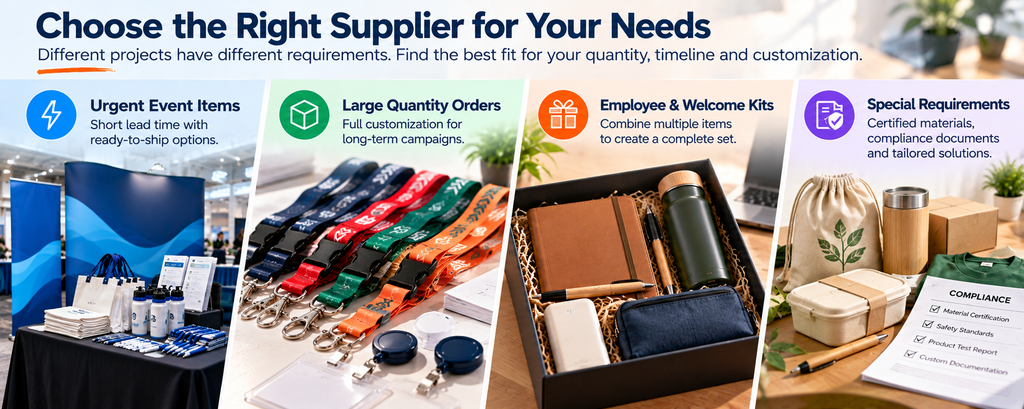
Scenario 1: A last-minute trade show
You need 200 printed pens and 100 notebooks within ten days.
A local supplier with stock available is probably the more practical starting point.
Scenario 2: A planned promotional campaign
You need 3,000 branded tote bags and 3,000 bottles for an event taking place in three months.
Overseas sourcing may be worth comparing, particularly if customization and total cost are important.
Scenario 3: A company welcome kit
You need several products packaged together with consistent branding.
The right supplier may be the one that can coordinate product selection, artwork, packaging and delivery—not necessarily the one with the lowest price for each individual item.
Scenario 4: An organization with strict purchasing procedures
Your company requires approved suppliers, specific compliance documentation or local invoicing arrangements.
These requirements should be considered before comparing prices.
The right choice is the supplier who can meet the project’s requirements with an acceptable balance of cost, quality, timing and purchasing convenience.
Final Thoughts
There isn’t one purchasing method that works best for every promotional merchandise project.
Local suppliers can be a sensible choice when speed, smaller quantities and purchasing convenience matter most.
Overseas sourcing may offer advantages for planned campaigns, larger quantities and more detailed customization.
The key is to compare like-for-like specifications, understand the complete delivered cost and confirm who is responsible for each stage of the order.
If you’re exploring overseas sourcing for an upcoming project, EV-PROMO can help you review product options, customization requirements and shipping arrangements before you decide how to proceed.
Visit EV-PROMO to explore promotional products and discuss your requirements.
Frequently Asked Questions
Is it cheaper to buy promotional products directly from overseas?
Not always. Larger custom orders may offer cost advantages, but shipping, taxes, setup fees and order quantity all affect the final price. Compare complete quotations rather than unit prices alone.
Are local promotional product suppliers faster?
They can be faster when products are already in stock locally. Custom-made products may still require production time, even when ordered through a domestic distributor.
Can overseas suppliers handle customs and delivery?
Some can arrange shipping options that include import clearance and duties, depending on the destination and agreed terms. Always confirm the exact responsibilities in writing.
How far in advance should I order custom promotional products?
That depends on the product, quantity, customization and shipping method. For an event, work backward from the date you need the products in hand and allow time for approvals, production and delivery.

